
Is My Text AI-Generated? A 5-Minute Self-Check Before You Publish
You have a draft. It’s tidy, it’s on time, and it reads fine. Too fine, maybe. Somewhere between the third “in today’s fast-paced world” and a conclusion that politely summarises everything you just said, a small voice asks: does this sound like a machine wrote it?
Maybe you drafted it with an AI assistant and edited it lightly. Maybe you wrote every word yourself and still can’t shake the feeling. Either way, the question is worth five minutes before you hit Publish. Not because using AI is a crime, but because readers can sense writing that nobody really stood behind.
Here’s a quick self-check you can run with a coffee, a red pen, and a timer.
Why the check matters (it’s not about guilt)
Let’s clear one thing up first: search engines aren’t hunting for AI fingerprints for their own sake. Google’s own guidance on AI-generated content says it rewards helpful, high-quality content, however it was produced. What it penalises is automation used mainly to game rankings. It also suggests asking who created a piece, how it was made, and why it exists.
That third question is the real test. Readers rarely run your post through a detector. They simply notice when it feels hollow: generic examples, no opinion, no lived detail. They leave, and they don’t come back.
So the goal isn’t to “beat” a scanner. It’s to make sure the piece sounds like a person with something to say, because that’s what keeps people reading.
The 5-minute self-check
Set a timer for five minutes. Spend one minute on each step, and mark anything that makes you wince.
Minute 1: Read your opening line out loud
AI drafts love a warm-up lap. Watch for openers like “In today’s digital landscape” or “Have you ever wondered…”. If your first sentence could sit on top of a thousand other articles, cut it. Start with the problem, a scene, or a claim your reader can argue with.
Minute 2: Hunt for the usual suspects
Skim for words that show up far more often in machine drafts than in human ones. A few to look out for:
“Delve,” “tapestry,” “realm,” “navigate the complexities”
“It’s important to note that…” and “In conclusion…”
“Not just X, but Y” constructions, used again and again
Everything grouped in neat threes
One of these is harmless. A cluster of them is a pattern readers recognise.
Minute 3: Check the rhythm
Look at the shape of your paragraphs. Machine text tends to march: every sentence a similar length, every paragraph the same size, every section ending with a tidy recap. Human writing wobbles. Add a short sentence. Let one paragraph run a little long. Break a pattern on purpose.
Minute 4: Find the fingerprints only you could leave
Ask yourself: what in this draft could only I have written? A number from your own data, a mistake you made, a client conversation, a strong opinion. If the answer is “nothing,” that’s your biggest problem, and no word swap will fix it. Add at least one specific detail per section.
Minute 5: Get a second opinion, then decide
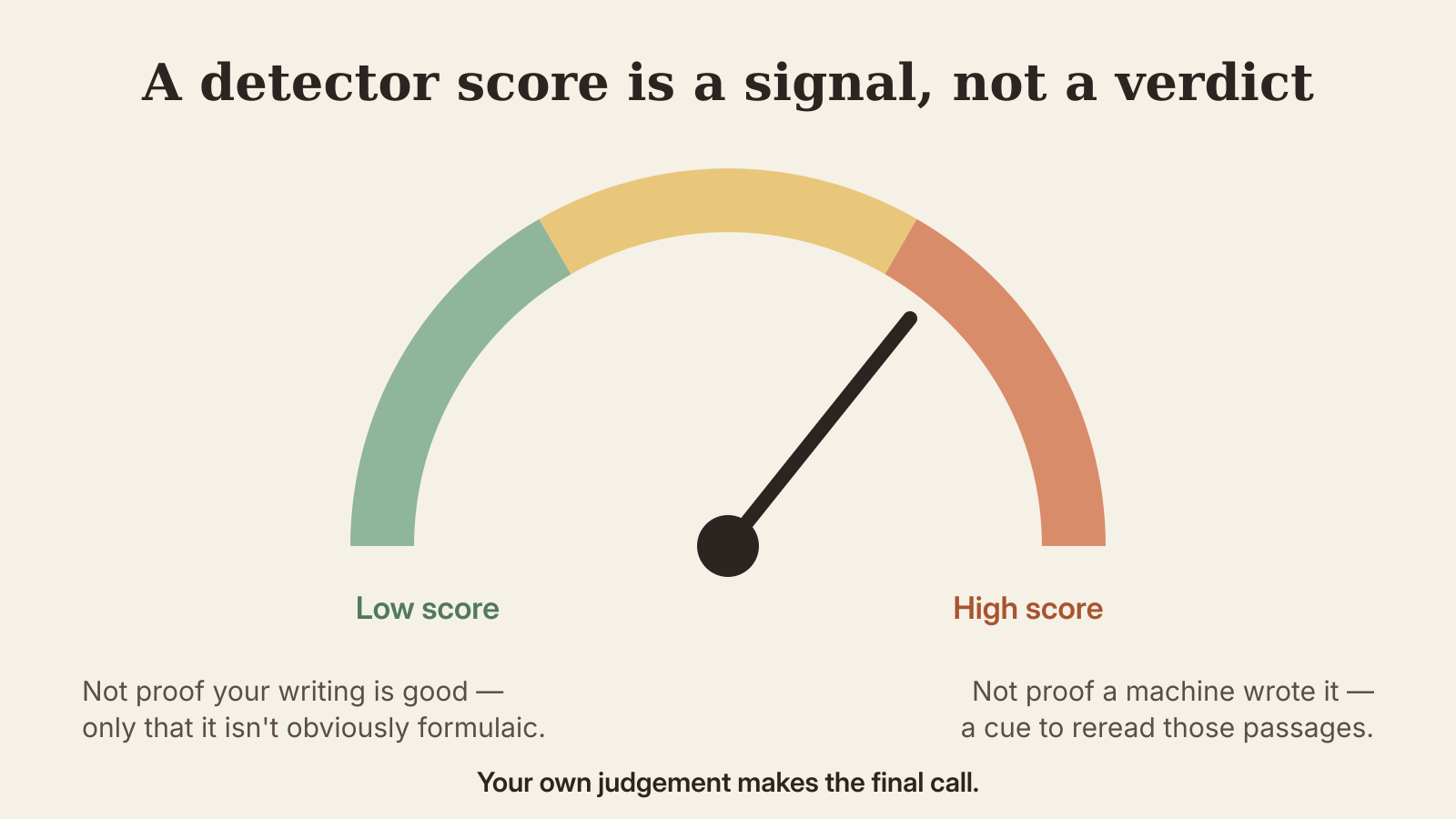
Paste the text into a free detector such as DetectGPT for an outside read. Treat the score as a prompt for a closer look, not a verdict. If it flags a passage, reread that passage with steps 2 to 4 in mind. If the score is high but you know you wrote it, trust the evidence of your own process over the percentage.
What a detector can (and can’t) tell you
Detectors are useful mirrors, but they are not lie detectors. Most of them measure how predictable your wording is. Plain, careful prose can look predictable even when a human wrote every word.
That has real consequences. A Stanford study reported by Stanford HAI found that seven popular detectors were near-perfect on essays by U.S. eighth-graders. Yet they labelled more than 61% of TOEFL essays by non-native English writers as AI-generated. The same study showed that asking an AI to “sound more literary” was often enough to slip past them.
The practical takeaway is simple:
- A low score doesn’t prove your writing is good. It only means it isn’t obviously formulaic.
- A high score doesn’t prove anything was machine-written. It means some passages are worth a second look.
- Your own judgement is the final check. You know how the piece was made; the tool doesn’t.
Quick fixes when something feels off
| If you notice… | Try this |
| A generic opening | Start with a moment, a number, or a bold claim |
| Stock phrases (“delve,” “tapestry”) | Replace them with the plain word you’d say out loud |
| Uniform sentence length | Mix in one very short sentence per paragraph |
| No personal detail | Add one example, quote, or result from your own work |
| A recap-style conclusion | End with a next step or a question instead |
| Hedging everywhere | Pick a side and say why |
Before you hit Publish
Five minutes won’t turn a weak draft into a great one. But it will catch the tells that make readers tune out, and it will remind you where your own voice belongs.
Use AI to draft if it helps you. Use a detector if it gives you a useful nudge. Just make sure the final version has your fingerprints on it, because readers come back for a person, not for a perfectly average paragraph.