
Healthcare SEO in the Age of AI Search: How Doctors and Hospitals Can Get Cited by AI

A patient searching for a hospital today may not begin with a hospital website.
They may ask Google, ChatGPT, Perplexity, or another AI search tool a question such as, “Who are the leading hospitals for robotic knee replacement?” or “What should I know before considering bariatric surgery?”
The answer may pull information from several websites and present it as a short summary with citations.
This changes the healthcare search journey.
Google now provides AI-generated answers for many queries. Tools such as ChatGPT and Perplexity can also summarise information from multiple sources. Instead of giving a patient ten links and leaving them to do the work, these systems can present an answer first and show selected sources behind it.
For healthcare organisations, that creates a new visibility problem.
A hospital can rank well for a valuable keyword and still be missing from the answer a patient actually reads.
Closing that gap is what AI search optimization focuses on, structuring answers so assistants like ChatGPT and Perplexity can quote them directly.
Think of an AI search system as a digital medical board. It can pull information from different sources, look for relevant evidence, and assemble an answer around the patient’s question. The sources it chooses become part of the patient’s research journey.
That is why healthcare SEO now needs to look beyond rankings.
The question is no longer only, “Can we rank for this search?”
It is also:
“Does our website contain information that an AI system can understand, trust, and use as a source?”
How to do Healthcare Seo in the Age of Ai Search?
SEO includes many things, like Off-page, On-page, and technical SEO. Healthcare SEO is even more specialised because Google treats medicine and health topics as YMYL and takes extra care when ranking these sites. Healthcare marketing agencies like GrowthPixel often specialise in these aspects. Here are some things you can do to get yourself or your clinic cited by AI.
Start With the Credentials Behind the Content
Medical information needs a higher level of trust than most other types of online content.
If a website publishes a recipe, a reader can decide whether it looks useful. If a website publishes advice about heart surgery, cancer treatment, or fertility, the standard is different.
Who wrote it?
Who reviewed it?
What makes that person qualified to discuss the subject?
Healthcare websites should make these answers obvious.
A doctor’s profile should not be a two-line bio followed by a phone number. Where appropriate, it should explain the doctor’s qualifications, speciality, experience, professional affiliations, areas of clinical interest, and relevant academic work.
The same applies to medical articles.
A detailed spinal surgery page becomes more credible when the author is identified, and the medical review process is clear. If the surgeon has published relevant research, linking to credible academic or institutional sources can provide additional context.
This closely connects to Google’s E-E-A-T principles: Experience, Expertise, Authoritativeness, and Trustworthiness.
This offers a practical lesson for hospital marketing teams.
Do not manufacture expertise through generic articles written under a doctor’s name. Put the doctor’s actual knowledge into the website.
A multispecialty hospital should also make its expertise scalable. Cardiology, orthopedics, oncology, gastroenterology, neurology, and other departments can each have their own content clusters while following a consistent structure for doctors, procedures, conditions, and supporting evidence.
That gives patients a clearer picture of the organisation. It also gives search systems more useful information.
Write Healthcare Pages Like a Well-organised Patient File
Imagine a specialist opening a patient file and finding symptoms on one page, medication history on another, test results buried in a paragraph, and the patient’s main complaint somewhere near the end.
The information may all be there.
It is still difficult to use.
Healthcare websites often make the same mistake.
A page starts with a long introduction, moves into general background information, adds a few keywords, and eventually reaches the answer the patient wanted in the first place.
AI systems have to process that structure too. A cleaner format starts with the question. For example,
What Is Robotic Knee Replacement?
Robotic knee replacement uses computer-assisted technology to help the surgeon plan and perform specific parts of knee replacement surgery with greater precision.
The page can then explain who may benefit, how the procedure works, possible risks, preparation, recovery, and alternatives.
The same format works for complicated subjects.
Who May Need Bariatric Surgery?
Give the short answer first.
Then explain eligibility, assessment, available procedures, expected lifestyle changes, risks, and follow-up.
How is Robotic Surgery Different From Open Surgery?
Answer the comparison directly. Then explain where each approach may be appropriate and why the final choice depends on the patient’s condition.
This helps patients scan the page quickly.
It is also useful for search systems because the relationship between the question and the answer is clear.
Short paragraphs help. So do bullet lists. Tables can help with genuine comparisons. Descriptive headings are better than clever ones. This is what AI is looking for and loves to cite.
For important treatment pages, aim to give a concise answer near the top of each major section. Then provide the clinical detail underneath. The key principle to remember is:
Answer first. Context follows.
That small change can make a large page much easier to use.
Build Seo Around Service Lines, Not a Pile of Keywords
Hospital SEO becomes complicated when every keyword is treated as a separate target.
A large hospital might have thousands of relevant searches. Trying to create a separate page for every phrase can quickly produce thin, repetitive content.
Service-line planning is more useful.
Suppose a hospital wants to grow its robotic bariatric surgery unit.
The obvious keyword is “robotic bariatric surgery.”
But that is only one part of the patient’s research. A potential patient may first ask:
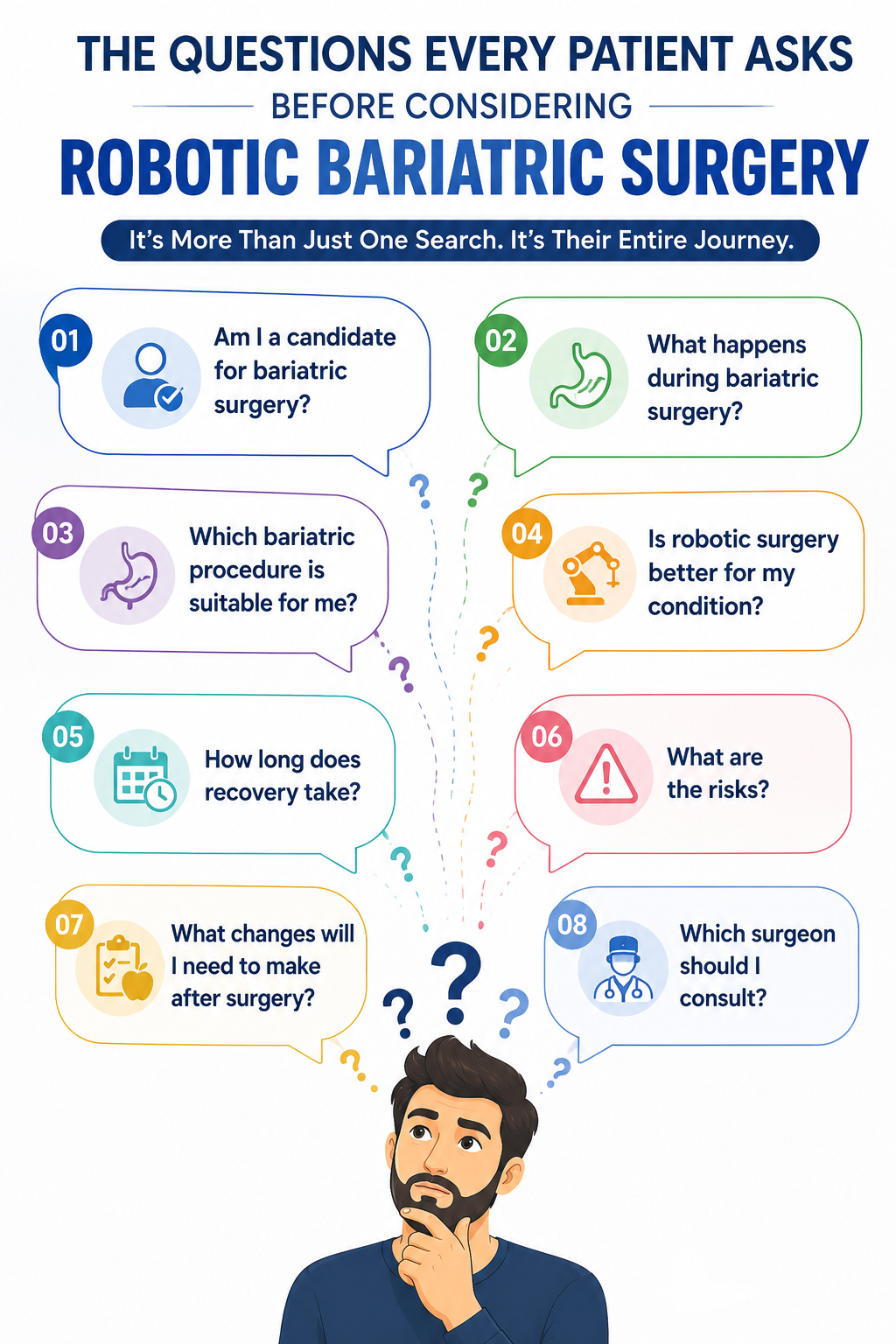
Those searches represent different stages of the decision.
Someone searching “what is bariatric surgery?” may still be exploring.
Someone comparing surgical approaches is much further along.
Someone searching for a surgeon or hospital is closer to taking action.
That is why high-value patient acquisition should be built around the entire search journey, not just the final commercial keyword.
The same model can be applied to neurosurgery, cardiovascular care, oncology, joint replacement, IVF, and specialised dental services. For dental service lines specifically, many practices pair this content strategy with a dental virtual assistant to manage the resulting patient enquiries and keep the acquisition funnel moving without adding front-desk headcount.
A medical SEO agency working with a tertiary-care hospital network should therefore ask a tougher question than “What keywords have search volume?”
It should ask:
Which searches support the growth of the hospital’s most important lines of care?
That shift can change the entire content plan.
Turn Search Intent Into a Patient Acquisition Funnel
SEO traffic has little value if it never reaches the right service.
Consider an elective orthopedic procedure.
The patient may start with a symptom search. A few days later, they may research a diagnosis. After speaking to a doctor, they may compare surgical options. Then they start looking at surgeons, hospitals, recovery times, costs, and possible risks.
Each stage needs different information.
A strong content funnel might look like this:
Symptom → Diagnosis → Treatment options → Procedure comparison → Specialist → Hospital → Consultation
This is digital triage.
Not every visitor belongs at the same stage.
A general educational article can help someone understand a condition. A detailed treatment page should help a patient who is evaluating a procedure. A surgeon profile and consultation page serve a different purpose again.
Hospitals should reflect those differences in their website architecture.
For example, a cardiovascular service line could connect:
- condition pages
- diagnostic information
- treatment options
- procedure pages
- specialist profiles
- recovery guidance
- patient FAQs
Now the website is not just a collection of pages.
It becomes a pathway.
This matters even more for high-value procedures where patients spend weeks or months researching before making a decision.
Content should never promise a particular result. Medical decisions are individual. Explain the options, evidence, risks, limitations, and factors that affect suitability.
Useful content builds trust.
Overstated claims can destroy it.
Make Your Medical Information Easy to Verify
A hospital website should not be an island.
If a doctor has published research, reference relevant academic work. If the doctor has an institutional affiliation, represent it accurately. If a procedure is supported by established clinical guidance, cite credible sources.
This creates several connected signals.
The doctor’s profile supports the article.
The article supports the treatment page.
The treatment page connects to the relevant department.
External academic or institutional sources provide additional evidence.
That structure is useful for people and search systems alike.
It also helps solve a common problem with healthcare content: the anonymous expert.
An article can sound impressive while giving the reader no way to judge who stands behind it.
That is especially risky when a healthcare brand publishes dozens of articles on complex subjects.
A hospital does not need to turn every page into an academic paper. It does need to be honest about expertise and careful about evidence.
A simple rule works well:
Do not merely claim that your organisation is authoritative. Make the supporting information visible.
Protect Patient Data While Measuring Marketing
Healthcare marketing teams want better attribution.
They need to know which channels generate enquiries. Hospital leaders want to understand the cost of acquiring patients. Service-line heads want to know whether investment in a particular procedure is producing meaningful demand.
The problem is that patient journeys can involve sensitive information.
A tracking pixel should not become an excuse to send unnecessary patient data to third-party platforms.
Before adding analytics or advertising tools, healthcare organisations should examine what is actually being collected.
Ask:
- Is personal information being captured?
- Is sensitive health information entering an analytics platform?
- Where does the data go?
- Who can access it?
- What consent is required?
- How long is the information retained?
- Does the setup meet the laws and contractual requirements that apply to the organisation?
US healthcare organisations may need to consider HIPAA requirements. Organisations operating elsewhere need to follow the privacy rules that apply in their own jurisdictions.
There are also alternatives to relying on unrestricted browser-based tracking for every conversion.
Privacy-aware first-party analytics, consent-based measurement, data minimisation, anonymised reporting, and carefully designed server-side systems can be considered where appropriate.
The technical setup should match the sensitivity of the information.
The same thinking applies to healthcare advertising.
Trying to bypass Google Ads or Meta policies is not a sustainable marketing strategy. If an advertisement is rejected, review the claim, targeting, landing page, and policy requirements instead of looking for a loophole.
Patient education should come before aggressive promotion.
Measure Marketing Like Patient Vital Signs
Hospital executives would never assess a patient’s condition using one number.
Blood pressure tells part of the story. Heart rate tells another part. A diagnosis comes from looking at the full picture.
Marketing needs the same discipline.
Organic traffic is useful.
It is not the diagnosis.
A healthcare organisation should also monitor:
- Qualified enquiries
- Consultation bookings
- Cost per qualified acquisition
- Treatment conversion rate
- Revenue by service line
- Patient lifetime value
- Branded search growth
- Organic visibility for priority procedures
- Performance of individual treatment pages
- AI search visibility for important patient questions
Consider two SEO campaigns.
Campaign A produces 100,000 visits.
Campaign B produces 10,000 visits, but generates more qualified consultations for a hospital’s high-value treatment service.
Which one performed better?
The answer is obvious once the right metric is being measured.
For larger hospital groups, CRM platforms can become part of this measurement system. Salesforce Health Cloud, for example, may be integrated into a broader healthcare technology stack where appropriate. The exact setup may be slightly different for each organisation.
The broader principle is more important than any single software product.
Connect marketing measurement to real outcomes where it can be done safely.
Do not stop at impressions and clicks.
What Should Hospitals do Now?
An AI-ready healthcare SEO strategy does not require abandoning traditional SEO.
It requires building better foundations.
Start with the service lines that matter most to the organisation. Map the questions patients ask at each stage. Create detailed treatment and procedure pages. Build supporting content around those pages rather than publishing random articles.
Then look at expertise.
Are doctors clearly identified? Can patients understand their qualifications and experience? Are medical reviewers named where appropriate? Are relevant sources linked?
Next, review the page structure.
Can someone find the answer in seconds? Are headings written around real questions? Does each section give a useful answer before moving into detail?
Then review measurement and privacy.
Know what your analytics systems collect. Remove unnecessary data. Make sure advertising and conversion tracking follow applicable requirements.
Finally, monitor AI search results for the questions that matter.
Search for your important procedures.
Search for your doctors.
Search for your hospital and major service lines.
Look at which organisations and sources are appearing.
You may discover something your traditional ranking report never showed you.
A competitor ranking below you in Google could still be appearing in the AI-generated answer.
That is a visibility gap worth investigating.
A generative engine optimization agency like Lureon can track which sources AI tools cite.
The New Healthcare Search Advantage
AI search does not make traditional SEO obsolete.
It raises the standard.
A healthcare website now needs more than keywords and backlinks. It needs identifiable expertise, useful information, strong page structure, credible evidence, sensible internal linking, technical accessibility, and responsible measurement.
For a doctor, that may begin with a stronger professional profile and better treatment content.
For a multispecialty clinic, it may mean organising dozens of services into clear content clusters.
For a hospital network, it can mean treating SEO as part of service-line growth rather than a standalone traffic channel.
And for a healthcare digital marketing agency, the work goes beyond ranking pages. It involves connecting clinical authority, content strategy, patient acquisition, analytics, and search visibility.
AI systems will continue to change.
The underlying requirement is much less complicated.
When a patient asks an important medical question, your organisation should have a clear, credible answer.
It should be easy to find.
It should be easy to understand.
And the expertise behind it should be easy to verify.
That is the foundation for becoming visible in the next generation of healthcare search.