
Is Plagiarism a Reason for De-Ranking of a Blog Post?

Plagiarism means copying web content and portraying it as your own in a blog post. The practice is as old as blogging itself.
When you look at the numbers analytically, they seem astonishing. Out of the 5.1 billion websites present in the world, more than 1.5 billion websites are guilty of posting copied content.
The situation gets worse when we go down to professional writing. As per the statistics, more than 75% of articles are either partially or completely plagiarized.
The situation has gotten out of hand. Seeing this disaster unfolding in front of our eyes, here are our thoughts about plagiarism’s impact on a blog post’s ranking.
Let’s start by understanding the types of plagiarism present in a blog post.
Types of Plagiarism
Plagiarism in a blog can be found in 4 different ways:
Direct Plagiarism
Direct plagiarism occurs when a blogger blatantly copies content from a source. It is the equivalent of intellectual dishonesty. The writer is effectively trying to deceive his audience by taking credit for work he hasn’t done.
Self-Plagiarism
This occurs when a blogger copies itself. Bloggers have to constantly update their content to stay relevant. During this, the chances of duplication increase.
Bloggers often use the same expressions to describe a situation, leading to a higher rate of plagiarism.
Mosaic Plagiarism
This means borrowing content from other blogs. It occurs when a blogger either copies others’ expressions or tries to rephrase their work.
Almost all bloggers have been guilty of this at some point. Instead of doing their research, they simply find an alternative way to express a thought.
The content generation is quicker. And often, the search engine fails to recognize the duplication. It is very hard to avoid the temptation of easy work.
Accidental Plagiarism
It happens when you unintentionally copy others’ work. As humans, we get inspired by others. The bloggers are no exception either.
Sometimes, the words and expressions of your peers find a place in your heart. While writing your blog, you accidentally start quoting the same expressions and examples. This is the power of creative writing.
However, accidental plagiarism is among the least occurring types.
Also Read: Best AI Content Writing Tools
Is Plagiarism a Reason for the De-Ranking of a Blog Post?
So far, we have discussed the types of plagiarism. However, this section deals with its consequences. We would like to highlight the following key points in this regard:
Statistical Analysis of Ranking Factors
The bloggers need to recognize the competition they face. According to the available data, in 2019, the number of internet bloggers was around 600 million. Now, three years later, the number has increased severalfold.
To rank well among them, you need to produce original, high-quality content. It should be engaging, readable, and relevant to rank on top of Google’s SERP.
Google considers more than 200 factors for ranking a blog post. However, the major ranking factors are shown in the graphics below: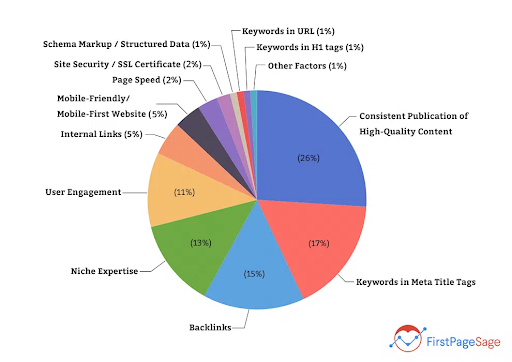
The data below highlights 2 main factors for SEO rankings:
- The high-quality content gets 26% weightage
- The Keywords placement gets 17%% weightage
Together, they account for 43% of a blog’s ranking. That means that, to rank well, a blogger should consistently produce non-plagiarized, unique content.
A plagiarized blog is destined for disaster. It would miss out on these two key SEO components.
Google Panda Update
We all know that Google is the primary search engine. It attracts more than 90% of all web traffic. To succeed in blogging means to rank at the top of Google’s SERP.
The latest Google updates have changed the blogging game on its head. The 3 important goals have been set for the latest updates; they include the fight against:
- Low-Quality Content
- Duplicate Content
- Spams
This cements the fact that the plagiarists aren’t going to get hidden now. The bots would never put such content on top. Only original content is the way to get to the top of Google Rankings.
Also Read: Best Grammar Checker Tools to Use
User-Engagement
While talking about search engine rankings, we can’t ignore user engagement. Google’s algorithms determine which content gets more screen time.
After that, it works to find similar work to improve the user experience. This acts as a great leveler. The low-quality work is filtered out organically.
People read a blog to gain insights into a particular topic. Humans, deep down inside, have a desire for knowledge. That is why knowing something new gives them a sense of joy. The people appreciate such work.
The duplication kills this thrill. The work looks like a burden that no one wants to carry. The people read a few lines to judge the work, then move on to the next blog.
And the real danger is that with more than 5 billion options available on every topic, they are highly likely to discard the website forever.
This decreases the organic traffic and the overall ranking of the blog post. The question is how to grow your blog.
The Remedy to Remove Plagiarism
The easiest way to remove plagiarism from a blog post is to use an online paraphraser. They are online tools that utilize AI to remove all types of plagiarism from a blog post.
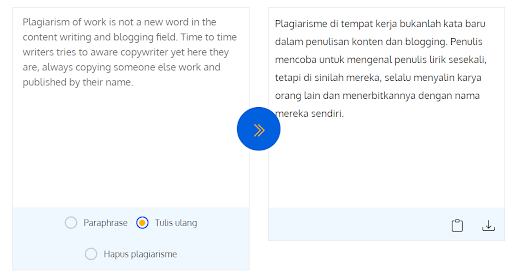
Besides that, they can improve the blog’s text quality. All of this is done while maintaining contextual accuracy; no detail is lost. The blog post looks professional and engaging.
For the reasons above, we believe every blogger should have a plagiarism remover in their arsenal. If used in the right spirit, they can help in producing plagiarism-free content consistently.
This, of course, would result in taking your blog post to the top of Google Rankings.
Also Read: Ad Copy Tools – Crafting Compelling Ads for SEM
Final Thoughts
Plagiarism isn’t a solution; it is a problem. Bloggers often commit plagiarism to stay active and relevant. However, this article explains how it contributes to the blog post’s de-ranking.
We have provided statistical evidence to support this claim and proposed an alternative solution. Give it a read and get back to us with your comments.