
How to Reduce Customer Acquisition Costs (CAC) with Automated Video Ad Testing

For Paid Media Managers and CMOs, the instability found on platforms such as Meta (Facebook/Instagram), TikTok, and LinkedIn has established a difficult truth: although algorithms are more intelligent, they are also more voracious. Consequently, they require a continuous flow of new information to improve results.
The main cause of increasing Customer Acquisition Costs (CAC) presently is not bad targeting layouts or wrong bidding plans; it is ad exhaustion. Viewers lose interest more quickly than production crews can generate content. When the frequency of ads goes up, click-through rates (CTR) drop, and CPMs (Cost Per Mille) rise drastically.
To address this issue, contemporary growth tactics are moving towards Automated Video Ad Testing. This method emphasizes fast-paced trials rather than “flawless” creation, using modular materials and AI to identify successful elements before increasing budgets.
Creative Fatigue that Kills ROI
Creative materials possess a “half-life.” While static pictures are simple to make, they frequently have the briefest existence and shallowest interaction levels. Video materials usually function better, holding interest for longer periods and explaining more complicated value propositions. However, the standard video creation process, scripting, filming, editing, and rendering, is sluggish and costly.
This results in a jam. If your CAC is increasing, it is probably because your successful advertisements have bored their viewers, and you do not have the quickness to substitute them with strong challengers. You are essentially paying a “fatigue tax” on every single view.
Moving From “Hero” Ads to Repeated Experimentation
In the past, companies spent a lot on “Hero” materials, one or two extremely polished commercials meant to be displayed for months. Within a performance marketing setting, this is a dangerous gamble. If that solitary high-priced item does not capture the viewers within the initial three seconds, the whole creation budget is lost.
The solution is repeated experiments. Instead of putting everything at risk on one concept, you look at a variety of versions of an idea and let the results determine which one is the winner. This requires a significant modification in the way advertising agencies view video material, not just as art or as tools to collect information.
The Method of Building using Modular Video
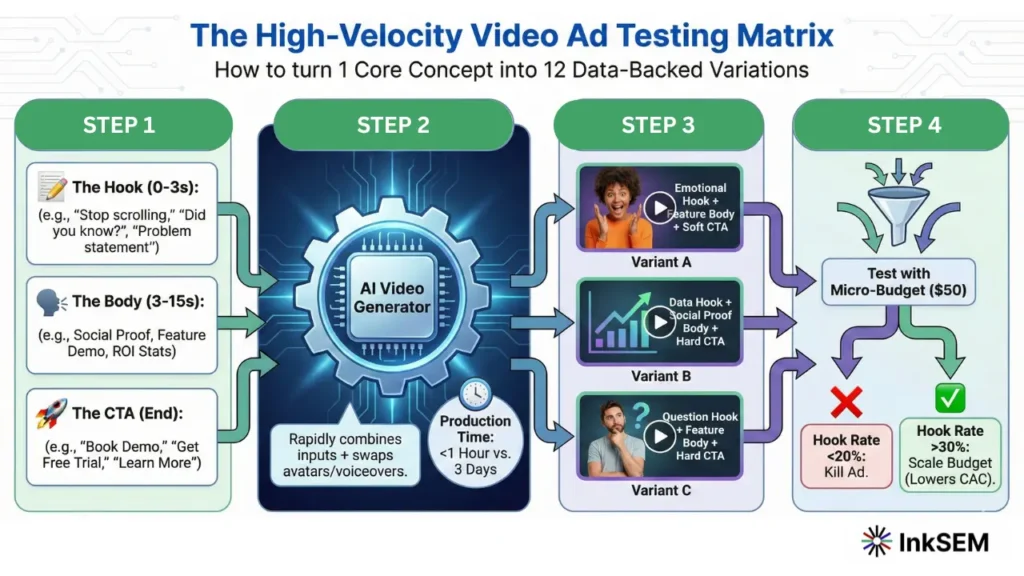
To carry out fast-paced testing without draining the funds of your design squad, you need to use a Modular Video Architecture. Consider your video advertisements not as solitary, fixed sculptures, but as formations constructed from LEGO blocks. A video ad is made up of separate modules:
- The Hook (0-3 seconds): The visual or audio distraction meant to halt the scroll.
- The Body (3-15 seconds): The value offer, problem/solution relationship, or social validation.
- The CTA (End Card): The particular direction provided to the watcher (e.g., “Shop Now,” “Learn More,” “Get 50% Off”).
If you treat them as interchangeable components, you will be able to dramatically improve your production. If you own three Hooks, two Bodies, and two CTAs, there is no need to have three videos, but you have 12 distinct versions to look at.
How Automation Can Help Expand
This is the place where technology links the plan to the actions. Hand editing 12 versions can be slow. With an AI video generator, teams can swiftly create a multitude of variations, modifying the presentation, the narration language, and the opening hook, without requiring an entire film crew or shooting reshoots.
Automation lets you arrange materials at a massive scale. It is possible to take one successful “Body” section and compare it against ten new “Hooks” created using AI avatars or remixes of stock footage. This transforms the task of creating from a deadlock into a huge possibility of testing.
Additionally, combining these activities along with AI tools to automate social media content can result in an easy process where things are not only created as they’re shared, but also analyzed in a rapid manner, ensuring that your test rhythm is in line with the algorithm’s desire for freshness.
The Process: A Protocol for Lowering CAC
To apply this tactic successfully, stick to this four-phase process intended to reduce waste and optimize knowledge.
Phase 1: Designing Theories and Scripts
It is not advisable to start with “an idea to make a video.” Start with a hypothesis about the client’s challenges. Find three different perspectives you want to examine.
- Angle A: Concentrates on the relationship between price and worth (Financial rationalization).
- Angle B: Focuses on the fear of not being noticed/standing (Emotional thinking).
- Angle C: Focuses on speed and simplicity (Convenience reason).
Create scripts that are modular. Be sure that your “Hook” is distinct from the “Body,” so they can be put together later.
Phase 2: Quick Creation
Make use of automated tools to create the material. If you’re employing user-generated content (UGC), ask the creators to keep the bodies and hooks separate from one another. If you’re making use of AI animations or motion graphics, you can create the avatars in large groups.
The aim in this case is “Minimum acceptable quality.” The clip doesn’t have to be the prize at a film festival, but it must be readable as well as loud enough and visually stunning. Costs of creation are often linked poorly with the results of feed-based platforms like TikTok or Reels, where the material that is not polished and real is successful.
Phase 3: The “Sandbox” Trial Campaign
It is not advisable to release an original creative idea straight into your main growth strategy. This is a recipe for wasting budget. Instead, create a “Sandbox” as well as a “Creative testing” campaign.
- Budget: Small daily expenses (e.g., $50-$100 for each advertisement set).
- Structure: Wide target. You must check the creative and not the audience. Let the creative be the screen for the viewers.
- Duration: Operate for between 48 and 72 hours or until the statistical significance has been achieved (typically between 2,000 and 3,000 impressions).
This stage acts as a sorter. It costs a small amount to find out the videos that are “failures” to ensure that you do not spend huge amounts of money on them later.
Phase 4: Expanding the Successful Ads
Once the information shows a champion, identified by exact metrics similar to Hook Rate or Cost Per Add-to-Cart, move that video to your primary expansion campaigns. Now you can assign a large budget behind it with certainty, understanding it has already shown its capability to sell.
At this point, you might also think about hiring a professional video marketing agency to take your successful idea and make a higher-quality version for television or connected TV (CTV) spots, mixing the speed of testing with the influence of high production standards.
Important Measurements to Watch (Ignoring Vanity Metrics)
To decrease CAC, you have to disregard vanity stats like “Views” or “Likes.” You need to gauge the effectiveness of your video as a funnel.
Hook Rate (3-Second View Rate)
- Formula: (3-Second Video Plays / Impressions) x 100
- Benchmark: Target >30%.
- Observation: If your Hook Rate is poor, your clip is not halting the scroll. The start of the video is the issue. No amount of convincing in the remainder of the clip matters if nobody views it.
Hold Rate (Average Watch Time)
- Observation: If you possess a high Hook Rate but watchers leave instantly after, your “Body” material is feeble or unrelated. The pledge made in the hook was not kept.
Click-Through Rate (CTR)
- Observation: This gauges the power of your call to action. If individuals watch to the finish but do not click, your deal is not persuasive enough, or the CTA was vague.
Conversion Rate (CVR)
- Observation: If you possess high clicks but poor sales, the gap is likely on your landing page, not the advertisement. To repair this, you may need to look into conversion rate optimization tools to guarantee the on-page encounter fits the hopes established by the video ad.
By separating these stats, you can determine exactly where a video is struggling and change only that particular module, rather than discarding the entire ad.
Conclusion
Lowering Customer Acquisition Costs in a tough market necessitates a change in attitude. You cannot depend only on the algorithm to locate your clients; you must supply the algorithm with the creative energy it requires to operate well.
Automated testing of video ads allows marketing departments to shift from a place of guessing to one of understanding. When you separate creative creation from expensive expenses and lengthy timelines, you can create an ongoing engine of growth. The businesses that will succeed in the next ten years are not the ones with the prettiest ads, but rather those that have the fastest feedback cycles.